Author Archives: April Zhu

China by Month

China by month

This article will recommend the best cities to visit in China and their unique highlights by month, helping you easily discover the top travel destinations for each month and plan an unforgettable, personalized journey across China.

MonthDestination CitiesHighlights
January Harbin (Heilongjiang) Step into a winter wonderland at the Harbin International Ice and Snow Festival, where dazzling ice sculptures light up the city. Embrace the snowy fun with skiing and sledding in Yabuli, or soak up fairy-tale charm in China Snow Town.
Hainan Escape to tropical paradise with sunny beaches, relaxing hot springs, and crystal-clear waters perfect for swimming and water sports. Don’t miss a walk through the lush rainforests for a touch of island adventure.
Yanji (Jilin) Discover snowy mountain views and vibrant winter markets in Yanji, where you can enjoy skiing and explore the unique blend of Korean-Chinese culture in this charming border city.
Xishuangbanna (Yunnan) Enjoy tropical warmth in winter as you explore lush rainforests, meet gentle giants in Wild Elephant Valley, and experience the colorful traditions of the Dai ethnic culture.
February Beijing Experience the magic of the Spring Festival Temple Fairs, and marvel at iconic landmarks like the Forbidden City, Great Wall, and Summer Palace, especially stunning with a dusting of snow. Warm up with hearty winter comfort foods like hotpot and dumplings.
Xi’an (Shaanxi) Celebrate the City Wall Lantern Festival with glowing displays and festive cheer. Explore world-class historical sites like the Terracotta Army, and treat your taste buds to Xi’an’s world-famous street food.
Chaozhou & Shantou (Guangdong) Immerse yourself in the lively Lunar New Year celebrations, explore the rich history of these charming cities, and indulge in a food lover’s paradise with delicious local dishes like Chaozhou-style dumplings and Shantou seafood.
Luoping (Yunnan) Visit the breathtaking golden canola flower fields during the International Canola Flower Festival, explore the stunning Jinji Peaks, and marvel at the beauty of Jiulong Waterfalls in this picturesque part of Yunnan.
March Hangzhou (Zhejiang) Enjoy the serene spring scenery of West Lake, stroll through Taiziwan Park to see cherry blossoms in full bloom, visit the lush Longjing tea plantations, and explore the cultural treasures of Lingyin Temple and Feilai Peak.
Nyingchi (Tibet) Celebrate the vibrant Peach Blossom Festival, marvel at the breathtaking Yarlung Tsangpo Grand Canyon, trek the majestic Mount Namcha Barwa, and enjoy the tranquil beauty of Basum Lake.
Suzhou (Jiangsu) Stroll through Suzhou’s classical gardens in full bloom, take a scenic boat ride along the canals and water towns, wander ancient streets, and visit the famous Tiger Hill for a glimpse of the city’s rich history.
April Shanxi Explore the awe-inspiring Yungang Grottoes, hike Mount Wutai, marvel at the Hanging Temple (Xuankong Si), feel the power of Hukou Waterfall, and step back in time in the ancient city of Pingyao.
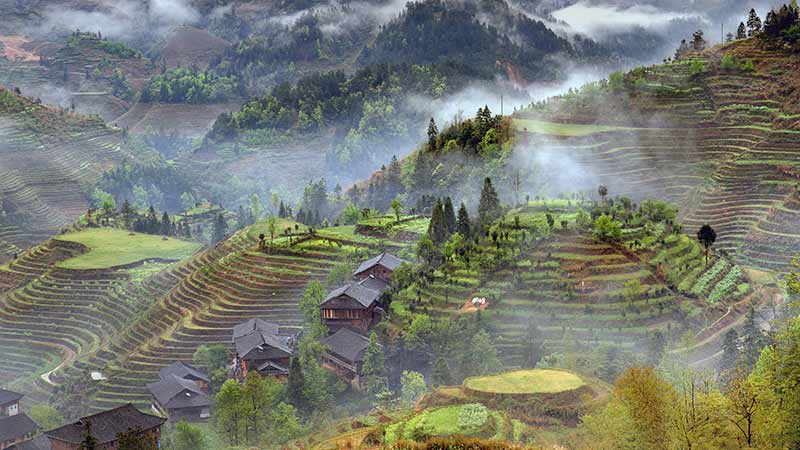
Bijie (Guizhou) Discover the vibrant Baili Azalea Nature Reserve, explore the stunning Zhijin Cave, enjoy the peaceful Caohai Nature Reserve, and immerse yourself in the culture of ethnic villages and scenic terraces.
Luoyang (Henan) Celebrate the stunning Luoyang Peony Festival, visit the historic Shaolin Temple, admire the ancient Longmen Grottoes, and savor the unique flavors of the traditional Luoyang Water Banquet.
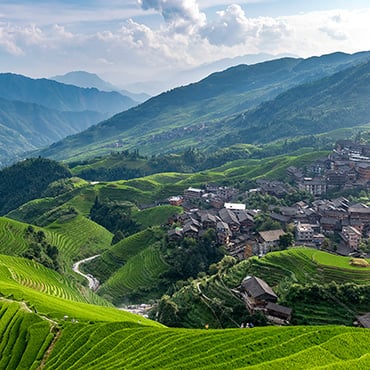
Guilin & Yangshuo (Guangxi) Embark on a scenic Li River cruise, enjoy bamboo rafting, marvel at the Longji Rice Terraces, experience traditional cormorant fishing, and take in the enchanting misty landscapes.
May Zhangjiajie (Hunan) Explore the iconic Zhangjiajie National Forest Park, ride the world’s longest cable car up Tianmen Mountain, discover the UNESCO-listed Wulingyuan Scenic Area, and enjoy a peaceful boat ride on Baofeng Lake.
Shangri-La (Yunnan) Admire vibrant wildflowers and green meadows with snow-capped mountains in the distance, explore the Songzanlin Monastery, wander through Potatso National Park and Napa Lake, trek the Shika Snow Mountain, and enjoy birdwatching and hiking in this serene paradise.
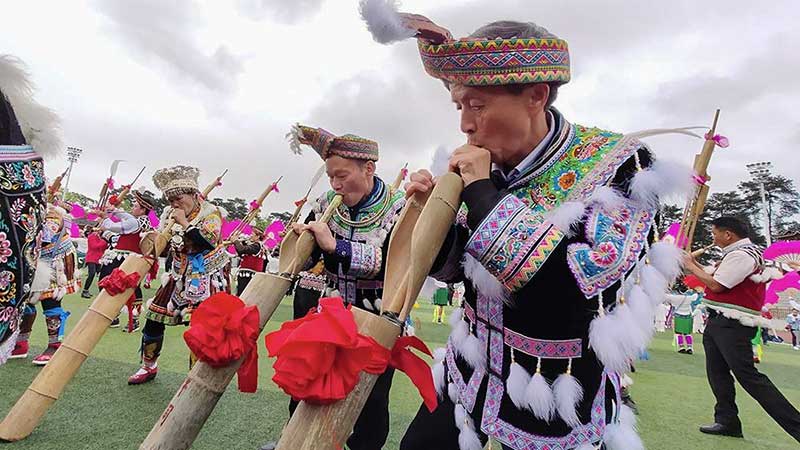
Leishan (Guizhou) Experience the vibrant culture of Xijiang Qianhu Miao Village with a traditional Miao welcome ceremony, enjoy a lively lusheng dance and evening gala, feast at a long table banquet, and stroll through a lantern-lit village with night markets, music, and bars.
June Foshan (Guangdong) Catch the thrilling Dragon Boat Races, experience Lingnan Tiandi and captivating Kung Fu shows, explore the historic Zumiao Temple and Qinghui Garden, hike Xiqiao Mountain, and savor the flavors of Shunde cuisine.
Chengdu (Sichuan) Visit the adorable pandas at the Panda Base, wander through the charming Kuanzhai Alley and Jinli, explore the Wuhou Shrine, hike Qingcheng Mountain, marvel at the ancient Dujiangyan irrigation system, discover Jiuzhaigou’s stunning landscapes, and see the majestic Leshan Buddha. Celebrate the Dragon Boat Festival and indulge in mouth-watering Sichuan cuisine.
Qinghai Marvel at the stunning Qinghai Lake and Bird Island, visit the sparkling Chaka Salt Lake, explore the vibrant culture of Xining, and enjoy the expansive beauty of the grasslands.
Xiamen (Fujian) Celebrate the colorful Phoenix Flower Festival, relax on Gulangyu Island, cycle along the coast, explore seaside parks, and immerse yourself in the arts and food hub of Zeng Cuo An. Don’t miss the lively night markets and fresh seafood.
July Guiyang & Anshun (Guizhou) Marvel at the stunning Huangguoshu Waterfall at its peak flow, explore the mysterious Dragon Palace Cave, hike Qianling Mountain Park (home to playful monkeys – please avoid direct contact), stroll through the charming Qingyan Ancient Town, and savor delicious local cuisine.
Jiuzhaigou (Sichuan) Discover Jiuzhaigou’s natural beauty as a summer resort, with the stunning Five Flower Lake, Wuhua Lake, and Five-Colored Pond. Admire the majestic Nuorilang Waterfall and enjoy peaceful walks on boardwalks and scenic forest hikes.
August Qingdao (Shandong) Join the excitement of the Qingdao International Beer Festival, Asia’s largest beer carnival, relax on beautiful beaches, hike Laoshan Mountain, visit the iconic Zhanqiao Pier, and indulge in delicious food and vibrant nightlife.
Dunhuang & Zhangye (Gansu) Admire the ancient Mogao Caves, explore the Singing Sand Dunes, visit the enchanting Crescent Lake, marvel at the colorful Danxia Rainbow Mountains, wander through the Qilian rapeseed flower fields, and discover the historical Jiayuguan Pass.
Hulunbuir Grassland (Inner Mongolia) Experience the vibrant Naadam Festival with horse racing, wrestling, archery, bonfires, and folk music. Explore the vast Hulunbuir Grassland with horseback riding, hiking, boating, nature walks, and stay in traditional yurts.
September Xinjiang Northern Xinjiang: Enjoy golden autumn forests, visit the stunning Kanas Lake and Hemu Village, embark on scenic road trips, and capture breathtaking photography at Sayram Lake and Narat Grassland.
Southern Xinjiang: Explore the Kashgar Old City, visit the impressive Id Kah Mosque, shop at the Sunday Market and Hotan Jade Bazaar, savor delicious Uyghur cuisine, and wander through lively night markets and orchards.
Huangshan (Anhui) Explore the majestic Mount Huangshan, visit the ancient villages of Hongcun and Xidi, and climb the serene Jiuhua Mountain. Experience local harvest fairs and vibrant lantern festivals that showcase the region’s rich culture.
Chongqing Cruise along the stunning Three Gorges on the Yangtze River, indulge in the city’s famous hotpot and delicious street food, explore bustling night markets, and visit iconic spots like Jiefangbei, Hongya Cave and the Liziba light rail station.
October Shanghai Enjoy the delicious hairy crab season, celebrate the Chrysanthemum Festival, take a scenic river cruise, shop along Nanjing Road, explore the historic Old Town, visit the beautiful Yu Garden, and wander the charming Zhujiajiao water town.
Western Sichuan Discover the stunning beauty of Daocheng Yading and Huanglong, trek the majestic Siguiang Mountain, explore the picturesque Miyaluo, and visit the serene Xinduqiao and Mugecuo for breathtaking landscapes.
Ningxia Experience the Wine & Grape Harvest with vineyard tours of the grape picking, and the wine tasting. Enjoy the thrilling desert adventures like sandboarding and sand sledding, camel trekking, and dune buggies in the Tengger Desert, and camping under the stars. Explore the Western Xia Tombs, Helan Mountain rock art, and the golden reeds of Shahu Lake. Immerse yourself in the Yellow River Cultural Festival, autumn harvest fairs, and savor the unique flavors of Hui food and folk arts.
November Nanjing (Jiangsu) Marvel at the autumn scenery with golden ginkgoes and fiery maples, explore the historic Purple Mountain and Qixia Mountain, attend the vibrant Nanjing Cultural Tourism Festival, and savor delicious local street food.
Lijiang (Yunnan) Wander through the charming Lijiang Old Town, visit the historic Mufu Mansion, immerse yourself in Naxi culture, taste the local cuisine, explore the majestic Jade Dragon Snow Mountain, and enjoy the beautiful view of Blue Moon Valley.
Tengchong (Yunnan) Explore the picturesque Ginkgo Village, relax in the hot springs and geothermal areas, visit the Beihai Wetland, admire Ming and Qing architecture, and discover local museums. Don’t miss the stunning Cherry Blossom Valley in spring.
December Jiangxi Admire the Sea of Clouds and rime at Mount Lu, visit the largest freshwater lake in China, Poyang Lake, a birdwatching paradise, explore the ancient ceramic city of Jingdezhen, and learn the history of Tengwang Pavilion.
Jilin Witness the stunning rime scenery at Wusong Island and Songhua River, attend the Chagan Lake Winter Fishing Festival, explore Changbai Mountain Ice & Snow World, and immerse yourself in Northeast folk customs and cuisine.
China by month

If you’re planning a trip to China, you’ll discover an exciting calendar of major events and exhibitions throughout the year. From cultural festivals to world-class trade shows and cutting-edge tech expos, every season offers unique experiences across the country’s vibrant cities. Whether you’re interested in tradition, innovation, art, or global business, China’s diverse events will immerse you in its dynamic energy and rich culture-making every visit fresh and memorable.

MonthEvent NameLocationKey Details
January Harbin Ice & Snow Festival Harbin Ice & Snow Festival Asia’s largest ice festival, featuring Ice and Snow World, Sun Island snow sculptures, and ice lantern displays.
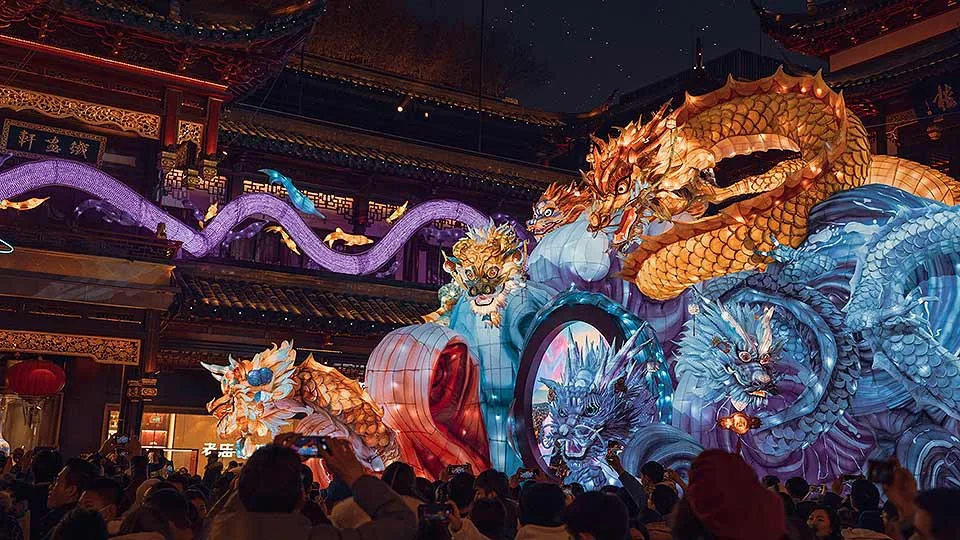
Yu Garden Lantern Festival Shanghai Traditional lantern displays with themes from Chinese mythology and pop culture.
March Formula 1 Chinese Grand Prix Shanghai Formula 1 race at Shanghai International Circuit, part of the global F1 calendar.
April Canton Fair (Spring Session) Guangzhou China Import & Export Fair is the world’s largest trade fair, showcasing electronics, machinery, and consumer goods.
The International Automotive Industry Exhibition Shanghai/Beijing Asia’s largest auto show, featuring global car brands and new energy vehicles. (Held in Shanghai in odd years and Beijing in even years each April.)
Weifang International Kite Festival Weifang (Shandong) Celebrates kite culture with competitions, displays, and cultural performances.
May China Beauty Expo Shanghai Asia’s largest B2B beauty industry event, featuring cosmetics, skincare, and wellness products.
June Shanghai International Film Festival Shanghai Premier film festival with global screenings, Golden Goblet Awards, and industry forums.
Guangzhou International Lighting Exhibition Guangzhou Asia’s largest lighting industry event, covering smart lighting and LED technologies.
August ChinaJoy Shanghai Asia’s largest gaming and digital entertainment expo, featuring e-sports, cosplay, and tech innovations.
October Canton Fair (Autumn Session) Guangzhou Autumn edition of the Canton Fair, focusing on home decor, gifts, and textiles.
November China International Import Expo (CIIE) Shanghai Global platform for trade in goods/services, featuring innovations in tech, healthcare, and consumer products.
Art021 Shanghai Contemporary Art Fair Shanghai Premier art fair showcasing contemporary works from global galleries.
The China Hi-Tech Fair (CHTF) Shenzhen (Guangdong) China’s premier tech expo, showcasing innovations like AI, robotics, and green energy to a global audience.

Terracotta Army

Terracotta Army

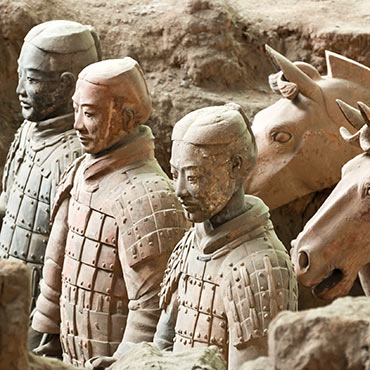
The Terracotta Army – or Terracotta Warriors as they are often referred to – is the number one reason travelers from all over the world visit Xi’an. Discovered by several humble farmers who were digging for water, it is hard to believe that nobody was even aware the Terracotta Army existed before 1974 when it was ‘resurrected’ after being buried for 2,200 years.

Causing a sensation when it was first discovered, the allure of this most unusual archaeological find endures today, so much that it is hard to believe visitors wouldn’t be impressed by the magnitude and vision the army represents.

Why is the Terracotta Army so amazing?

Why is the Terracotta Army so amazing?

There are many things that make the Terracotta Army so remarkable, however perhaps one of the most surprising things is that nothing was known of them until around 50 years ago. Why is that? It’s a perplexing question, given so much is known about Emperor Qin Shi Huang Di, the man who commissioned its creation. In fact, the existence of the emperor’s mausoleum was very well documented in historical records, which show work on the mausoleum commenced when Emperor Qin became ruler at the tender age of 13 years. However, despite these detailed historical records, no mention was made of the Terracotta Army.

So why was the tomb built? Why indeed!

Ying Zheng came to the throne as the King of Qin in 247BC. Between 230BC and 221BC, Qin conquered the other six kingdoms and unified China. Ying Zheng called himself Emperor Qin Shi Huang, the first emperor of the Qin dynasty, and he ruled China after the unification from 221BC to 206BC. His mausoleum is just one of the examples of his larger-than-life vision for his kingdom.

According to traditional Chinese beliefs, construction on the Emperor’s tomb commences as soon as the individual assumes power. A long construction time was directly correlated with a long life for the emperor.

Who built the Terracotta Army?

Who built the Terracotta Army?

Historical records indicate over 720,000 people (yes, you read that right) were involved in the design and construction of the world’s largest underground army. It took almost 40 years to complete the tomb. Actually, it would have taken longer, however towards the end of Emperor Qin’s rule, a peasant uprising broke out, which meant those involved in construction were needed elsewhere to go to war. The impact of this war was far reaching. Archaeologists believe one reason so much damage has occurred to the soldiers is because the bronze weapons held by statues were taken for fighting purposes.

While these facts are amazing, there are many others that distinguish this iconic attraction in China.

From a purely artistic perspective, the Terracotta Army is an amazingly creative feat, especially considering how advanced the design is. Intricate details found in every figure, chariot, and weapon are a testament to the workmanship and tenacity of those involved in the construction of the enormous mausoleum and everything in it. You’ll discover this when you finally meet ‘face to face’ with the soldiers yourself.

There is no doubt the life-like nature and life size of the statues, each of which is completely different, contributes to the mystique and aura of the army. Incredibly, no two statues are alike, and archaeologists have wondered if each face is that of an actual soldier. In truth, we will probably never know, but seeing the soldiers in person gives an almost eerie feeling that you are staring straight into the eyes of a real person from the past.

The Terracotta Army tells a story.

The Terracotta Army tells a story.

All elements in the tomb combine to give visitors a unique insight to what life was like during the period of Emperor Qin’s reign. From the depiction of nature, to the clothes worn by soldiers, to the weaponry and beautiful treasures found throughout, it has been possible to deepen the understanding of China’s rich history at this time.

Each soldier is 1.7 to 1.8 meters high and crafted on solid legs. Heads were made separately, only to be added when the figure was finished and transferred to the mausoleum. In fact, this ‘design flaw’ is one reason there are so many soldiers who are having ‘cosmetic’ work done at the army ‘hospital’. The weight of heads left them prone to breaking off and falling to the ground. Considering the average weight for each soldier is about 200 kilograms, or 440 pounds, it’s hardly surprising the heads felt a little heavy for the statues to hold up permanently.

Something you will notice immediately about the soldiers is the order, which reflects a true battle formation. Consistent with real life at the time, the army is made up of infantrymen, charioteers, kneeling archers, standing archers, and even generals. How do we know? Each rank of soldier is distinguished by clothes, hairstyles, armor, shoes, and weapons.

When you visit the museum, you will have the opportunity to see exactly what was discovered when archaeologists first uncovered the tombs. You can follow the progression of restoration, from the original pit that was excavated, the repair work in progress at the army’s hospital where damaged soldiers, horses, and chariots are put back together, and the fully restored figures. A number of specially encased statues allow visitors a close up view of all the details so carefully captured in each and every figure.

A few facts about the pits

A few facts about the pits

A visit to the Terracotta Army is not something completed in half an hour. Rather, you will want to allow time to savor the experience. Archeologists and the museum’s curators have designed the museum to allow for optimal viewing, probably not something that was possible at the time of construction.

There are three major exhibition rooms, which display three enormous pits. Pit 1 was the first to come to light when the Terracotta Army was first discovered. It is the largest of the three with over 6,000 warriors, of which 2,500 have been excavated. Pit 3 is the smallest and was the last to be discovered. Even so, it is considered the most important as it’s believed to be headquarters for the army. Pit 2 is special for a different reason – for the details found on each of the statues. What kind of details, you ask? You can look closely and see wrinkled foreheads, the fine hair of eyebrows, distinctive moustaches and beards, shoes, and more. An ‘added extra’ is found in the temporary exhibition room which contains an original and replica of two bronze chariots discovered in the Bronze Chariot Pit.

While it’s said that the Terracotta Army was buried, in fact, this is not completely true. You will see, huge pits were dug to house the army, while the floors were paved with bricks. Petitions were constructed to form corridors in which the warriors were lined up in military formation. A roof constructed of timber beams and packed earth covered the pits.

The truth is, there is simply so much to see here, a visit to the museum is not something you want to rush. Considering it was nearly 40 years in the making, it’s wise to allow at least half a day to enjoy every part of it. A knowledgeable guide will add to your experience, helping you to understand the detail behind this amazing historical legacy.

Entry Prices
Adults¥120
Children under 16 years and taller than 140cm¥60
Children under 16 years and under 140cmFree
Food YesOn site canteen with food and drink menu, including coffee
Transport YesCar (taxi)
Metro Line 1. Change to Line 9 at Fangshicheng Station. Arrive Uha Wing Chi Station and change to Bus 602 to Terracotta Army.
Take Bus 307 at Big Wild Goose Pagoda stop and arrive at the Terracotta Army.
Take Bus 915 at San Fu Wan Transport Terminal to the last stop at Terracotta Army.
Tours YesPrivate guided tours and audio tours available
Family friendly Yes
Close to city YesLocated approximately 1 hour by car from the city heart
Opening hoursMonday – Sunday8:30 – 17:00 1 Mar to 30 Nov
8:30 – 16:30 1 Dec to 28 Feb
Items of note YesMuseum shop with books, figures, and artworks available for purchase
Jing architecture

More secrets of ancient Chinese architecture styles: Insider tips for Western travelers

Jing architecture

Different styles, different places

We’ve mentioned that a good rule of thumb to apply in the study of ancient Chinese architecture is that each distinct style is associated with a particular region.

For those wanting to know a little more, here’s a quick summary of the architecture style and corresponding region and features.

Architecture styleRegionFeatures
Wan (皖派)AnhuiGrey blue tiles, white walls, and carved bricks
Su (苏派)Jiangsu and ZhejiangHills, water, and winding paths
Min (闵派)FujianEarth building defense function
Jing (京派)BeijingSymmetrical courtyard layout, Chinese cultural symbol
Jin (晋派)Shanxi, Shaanxi, Ningxia and GansuCave houses, historical culture of the Shanxi merchants
Chuan (川派)Sichuan, Yunnan and GuizhouStilt houses, colorful ethnic minority features

In this blog, we’re covering the Jing, Jin, and Chuan styles of architecture, but you can read about the other styles here.

So, let’s explore!

Jing style architecture

Jing architecture

Jing style architecture is synonymous with symmetrical distribution and good wishes. The dominant feature of Jing style is the quadrangle shaped courtyard, an element that has evolved over 700 years.

Found predominantly in Beijing (hence the name Jing), this style is very common in China’s north; mostly in Beijing and rural Shanxi. 

Any time spent in China will mean you become very well acquainted with the Siheyuan, which is the style of building most frequently associated with Jing style. A Siheyuan is a type of residence, but throughout Chinese history, this style of building has been used for residences, palaces, temples, monasteries, family businesses, and even government offices.

Jing architecture
Jing architecture

Perhaps the finest example of Jing style architecture and the Siheyuan is the Forbidden City located in the heart of Beijing. In fact, it can be regarded as an enormous Siheyuan where mastery of this architectural style was achieved. Often beautifully adorned, in the most beautiful Siheyuan you will find ornate carvings, colourful decorative painting, intricate carvings, and more.

It’s not surprising then that in the past, a large Siheyuan was a sign of wealth, importance, and prosperity. They would often house a large, extended family. Even today, those that still stand are used as accommodation, having been subdivided and in some cases, retrofitted with amenities.

Jing architecture

If you take a Beijing tour or include Beijing in your China tour (a must!), take some time to visit the city’s most expensive real estate, the hutong. In this old part of Beijing, you’ll discover many Siheyuan still providing accommodation to locals. Going beyond the practical function of housing, a Siheyuan is a point of connection for residents who use their courtyards to engage with one another. The natural by product is a meaningful shared history.

Jing architecture

Historically, there were over 26,000 Siheyuan in Beijing, however, by 2012 just over 900 were in a well-preserved condition. Although there aren’t as many, the symbolism, tradition and meaning of the Siheyuan endures today.

Jin style architecture

Jing architecture

Jin style architecture is a style of architecture found in China’s northern Shanxi province, referring to parts of Shaanxi, Gansu, Ningxia, and Qinghai.

The earliest examples of Jin style architecture include the murals and carvings found in caves. In fact, millions of people who call the Loess Plateau home reside in cave dwellings, just as they have for thousands of years. There is a logic to this practice. Caves are cool in summer and warm in winter.

Jing architecture

By contrast, Jin style architecture also refers to the unique style of buildings and decorations that developed in close association with China’s well-known Shanxi merchants. The influence of the Jin merchants on this style of architecture is pervasive and there are many wonderful testaments to it in buildings that still stand today. 

One beautiful example is the Qiao family courtyard. It includes an incredible 300 houses and six courtyards throughout! Others can be found in Pingyao City Wall, the market street of Pingyao ancient city, and the Wang family compound in Lingshi. 

Chuan style architecture

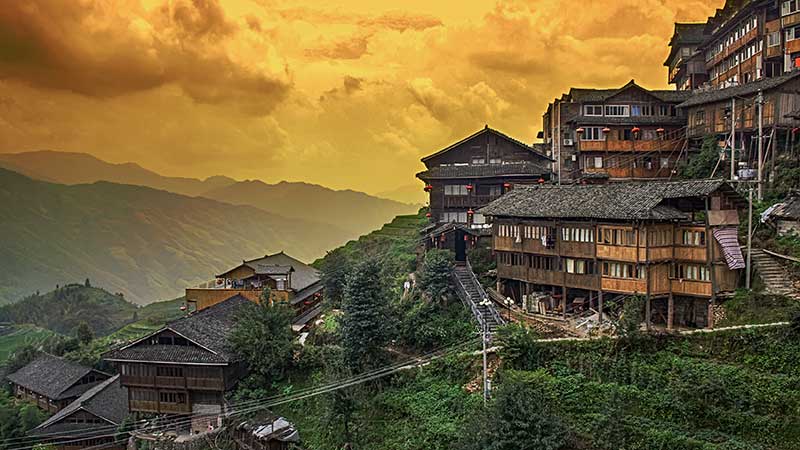
Chuan-style architecture is an architectural style that is popular in Sichuan, Yunnan and Guizhou. More specifically, it is an architectural style peculiar to the local minority people. 

Jing architecture

Like the cave dwellings of the Jin style, the geography of Chuan architecture has influenced the location of structures, which are built along mountains, small hills, and rivers. Each minority has crafted its own particular features and these distinctions can be found in the Dai minority’s bamboo tower, the Dong minority drum tower, and the Diaojiaolou stilted tower in western Sichuan.

Jing architecture

The bamboo house of the Dai nationality has been used for over 1,400 years. The lower level of the house is about seven or eight feet high to prevent the house from being flooded, as this style of the house is found in areas of high rainfall. Animals are tied to house posts, while the upper level is reserved for living and storage. A characteristic fire is found in the middle of the building, burning day and night for cooking and warmth.

The Dong minority people forged their own architectural style. It is best represented in the Drum Tower, which is found in every Dong village, usually on the flat or high grounds in the village center. An important focal point for all public village activities, the Drum Tower is surrounded by a square where people can gather. The pavilions are shaped like pagodas, with the landscape, flowers, dragons, phoenix, birds and ancient figures painted or sculpted on the eaves.

Jing architecture

Dong minority residences are built on stilts and three or four stories high. Wood is the main material used, although roofs are tiled, and in some regions, the corridors and eaves of houses are connected.

The Diaojiaolou also belongs to this category of stilted or ganlan style buildings. Diaojiaolou is usually two or three floors and are supported by a base made of stone. The deceptively simple architecture hides the true ingenuity of these buildings, which rely on groove joints to hold columns and beams together, rather than nails. 

The height of the buildings also plays a crucial role in survival and wellbeing. Ample ventilation protects against humidity. The building design also helps protect against the threats posed by the natural environment. With venomous snakes, floods and earthquakes among these, it’s any wonder this building design has endured for centuries.

A final word

It’s difficult in just a couple of articles to do justice to the diverse traditional architectural styles in China, but future travelers can gain a sense of what appeals to them and plan their China tour accordingly, remembering there is much to learn about the people who created it and the history and culture behind it. 

If you’re curious about a particular region or architectural style, look for a tour that allows you time to learn and explore by getting up close over a period of days. That way, you’ll come away with a deeper sense of connection and understanding – and that is certainly the content of more meaningful travel memories.

** Information for this article was sourced from Wikipedia, whc.unexco.org,  and WeChat Public Account ID: www1shoucangcom

ChinaTours.com is dedicated to helping western travelers from the United States, United Kingdom, Australia, Canada, and elsewhere enjoy an authentic experience of China, including those keen to learn and appreciate more of China’s traditional Chinese architecture styles found in Beijing, Shanxi, and Sichuan. Many of our tours provide the opportunity for immersion in a culture and place for a day or a number of days, allowing more time to learn about the people. We can also tailor a tour that covers an area or region that is of particular interest to you. Want to know more? Just ask us! We’re here to share your passion for learning and all things culture-related. Enquire via our contact form and we’ll respond within 24 hours.

How to plan a trip to China

How to plan a trip to China: Get past the overwhelm (and get excited)

How to plan a trip to China

The specifics of how to plan a trip to China can stump even the most experienced of international travelers. Amidst the challenges posed by the many China ‘unknowns’, you might even wonder where to start with making arrangements.

While asking friends and family who’ve been there, done that can be helpful, sometimes, it can create even more confusion. One person’s negative experience can taint your perception and leave you unnecessarily concerned about planning your travel arrangements. It might even make you apprehensive about how to manage once you’re on the ground.

If you’ve scoured Google for every tip and trick on how to plan a trip to China, you’ve probably discovered much of what’s written comes from lifestyle bloggers. Sure, you’ll find some helpful information, but many of these bloggers have planned and prepared for just a single trip to China.

Over a decade of researching, designing and planning holidays to China means we know a thing or two about how to create beautiful travel memories for customers, so in the spirit of transparency, we’re sharing our insider knowledge about how to plan a trip to China when you have no idea where to start.

Let’s do this!

How to plan a trip to China: Start with destinations

How to plan a trip to China

If this is your first trip to China, your biggest hurdle will be narrowing down your list of must-see destinations.

Covering a landmass that is larger than either Australia or the USA, this won’t be an easy task, so it’s essential you pull out a map before you get too far into your planning.

A quick scan and you’ll soon see that favourite destinations like Beijing, Shanghai, and Lhasa aren’t exactly within easy reach of each other (they’re actually three corners of a very large triangle across the country!). So knowing how to make plans for your China trip means understanding travel distances and the potential limitations imposed by geography, available transport, and accessibility.

Fortunately, we’ve got you covered with our list of recommended destinations for first time China trippers. Plan to visit Beijing, Xian, Guilin, Chengdu, and Shanghai, however if your schedule doesn’t allow, stick with the Golden Triangle – Beijing, Xian, and Shanghai.

Explore these recommendations from our CEO  for anyone planning their first trip to China.

Making plans for a China holiday: Getting there and getting around

How to plan a trip to China

The destinations at which you start and finish your trip will be dictated to some extent by the city you fly into.

Beijing and Guangzhou are the main international arrival hubs, but they’re not the only ones, so you may want to consider how to get the best deal to save money on flights, keeping in mind you may need to book in country flights or train travel.

Booking international flights yourself, rather than relying on a travel agency, means more holiday spending dollars in your pocket. Be sure to access these flights directly from an airline’s website instead of third party booking platforms. You might even be lucky enough to find a great seasonal promotion or offer.

Another point to keep in mind is that international flights with a stopover are less expensive than direct flights. If you don’t mind the longer travel time – or you want to take advantage of the opportunity to visit another destination, this is a great way to see more of the world. US travelers flying from Los Angeles to Beijing could stop in Tokyo for a couple of days. Similarly, if you’re on route from Shanghai to LA, why not consider two days in Osaka? Breaking up your travel this way just makes sense, and with leisure travel plans seriously curtailed, we envisage travelers will look for ways to maximise their vacations when borders reopen.

Choosing an China travel company: How to know what’s best

How to plan a trip to China

When it comes to choosing an in-country China travel company, the decision-making process can become very confusing, very quickly.

As tourism has boomed over the past decade, we’ve seen astronomical growth in China-based travel companies. It has become highly competitive, which is great for western travelers. It means you can pick and choose a provider according to your values.

As travelers ourselves, we always look for companies that tailor the experience to what the customer really wants; not what they think the customer wants. It’s on this point that many China travel agencies miss the mark. For example, companies offering commission-based shopping don’t realise that the majority of western travelers seek a real experience of China, not a shopping expedition. The opportunity to meet and connect with locals and their culture has far more value to them than visiting an overpriced retail outlet selling wares of questionable authenticity.

Another important tip: if you can, avoid making price your number one buying decision. Because there is such a vast difference between the good, the average, and everything in between, it pays to spend time doing your research.

Ask questions like what hotel chains do they use and where are they located? A quality hotel located in a premium city location means less time lost on unnecessary travel to and from sights. China’s big cities are notorious for their traffic, which seems to be on a perpetual peak hour. It’s not uncommon to be delayed a least an hour because of busy roads.

Choose wisely when traveling with a guide

How to plan a trip to China

Tour guides can make or break your experience, so it doesn’t hurt to investigate the quality of guides used by the company. This is easily done by checking out online reviews

Experience tells us that a China travel agency with quality guides is worth its weight. With their ability to share deep local knowledge, an appreciation for service, and a sense of humour, for many customers, a wonderful guide adds to your bank of travel memories. Often, the connection made with local China guides is the best opportunity for customers to connect with a local and really understand a little more about Chinese culture.

We understand how pivotal a guide is to our customers’ travel experience and it’s why we’ve continued to invest in attracting and retaining the best guides.

Planning your China trip: Deciding the best time to travel

How to plan a trip to China

The challenge with deciding the best time for a trip to China is coming up with a simple answer. This is because there are so many things to consider: Seasons, destinations and highlights on your bucket list, personal interests (are you fascinated by history, but not a fan of big cities?), how much time you have, and of course, your budget. 

As a general rule, there is no one best time to go to China, however the most common advice from those who know is to plan your travel for April, May, September and October. Why? Well, these are the most enjoyable from a weather and season perspective.

Spring falls in April and May (and March), making these months ideal times to visit China. Equally appealing for seasonal travel are September and October, when it is Fall in the northern hemisphere. As the months that land either side of the super busy, crowded Summer, planning your holiday to align with these times will make for comfortable travel weather. It also means avoiding the bitter cold of winter, which is a feature of high traffic destinations like Beijing or Tibet or bypassing the searing heat of places like Turpan or even Shanghai with its more humid climate. 

If the weather doesn’t bother you, traveling in the off-season means there are smaller crowds of domestic and foreign travelers, which in itself can make for a more enjoyable time.

Getting organized: Visas and money

How to plan a trip to China

China is a country where a visa is required for most international travelers, however, changes made in 2024 that are in place until the end of 2025 have loosened visa restrictions. If you are planning a two week holiday, for example, there is good news. China has made it easy for international travelers from many destinations. In July 2024 it was announced that from December 1 2023 to December 31 2025, China has implemented a unilateral visa-free policy for ordinary passport holders from 15 countries: Germany, France, Italy, the Netherlands, Spain, Malaysia, Switzerland, Ireland, Hungary, Austria, Belgium, Luxembourg, New Zealand, Australia, and Poland. Citizens from these countries are eligible for a visa-free entry if they come to China for business, tourism, visiting relatives and friends and transit for no more than 15 days. If, however, you are traveling from elsewhere, don’t be overwhelmed by the visa application process. If you’ve booked a tour, your travel agency can help by providing the items required for your application.

You will need an invitation letter and the details relating to destinations, as well as how long and where you’re staying. Photos and the completed application form are also required. Whether you’re traveling as part of a small group, private, or custom China tour package, be prepared to do a little legwork to meet all the China visa requirements

The best way is to connect with your local China Embassy, Consulate, or Visa Application Center to understand where the application process fits in terms of timing for your travel arrangements. If in doubt, ask for help from your travel agency. They can advise of any changes which may affect your application or travel.

In terms of money and payments, a visit to China is not complete unless you’re purchasing with Alipay and WeChat Pay. These two apps are ubiquitous, so it makes sense to download them on arrival. China is very much a cashless economy. You’ll quickly discover that even street food stall holders accept payment via WeChat Pay and AliPay. 

Credit cards are also accepted widely throughout China, although a certain amount of cash is a necessity. Let’s say you’re traveling on the 8 day Beijing, Xian and Shanghai tour, allow for USD1000 to buy small souvenirs, handcrafts, meals, and pay gratuities to guides and drivers in every city.

Small group, private or custom tour? Which should you choose?

How to plan a trip to China

There is nothing worse than embarking on the holiday you’ve been planning for months only to discover you are herded about like sheep in a large group by your trusty guide.

Apart from the opportunity to connect with a friendly, knowledgeable local, small group, private or custom tours are simply a much more enjoyable way to experience China. 

Our small group tour numbers are capped at 12 people, while our private and custom tours are even smaller, accommodating only you and your family or friends. A small group tour is an ideal choice if you’re happy to hit the road with other like-minded travelers. Go for a private or custom tour if you’d prefer extra flexibility. This applies especially to custom tours where you can create your own adventure. 

Read any review from western travelers who’ve chosen one of these options and you’ll see why they’re so popular. And if you’re stuck for suggestions, here are our CEO’s top recommendations for first time travelers to China.

Recommended tour DestinationsWhy take the tour
8 Days Golden Ring of ChinaBeijing, Xian, ShanghaiA perfect snapshot of China’s most iconic highlights in a manageable week long itinerary
11 Days Beauty of ChinaBeijing, Xian, Guilin, ShanghaiCity bustle, China’s iconic historical landmarks, and natural beauty
12 Days Odyssey of YangtzeBeijing, Xian, Chongqing, Yangtze River, ShanghaiThe famous Golden Triangle of Beijing, Xian, Shanghai with the bonus of Chongqing and a Yangtze cruise

A final word on planning your China trip

There are many resources for finessing the details of your trip to China, however one of the best you’ll find is a competent, caring travel consultant. With experience and knowledge of what works best down to the last detail, you can feel confident that by working together you’ll experience China as the kind of place you always imagined it would be.

Experienced international traveler, but finding it hard to get the details right for the ideal trip to China? Relax! We can help. Explore our library of articles about all things China travel, or simply get in touch to discover what’s really possible when you plan and design a tour with people who truly care about your experience. We welcome online enquiries via direct contact and with responses delivered within 24 hours, we’re sure we can help create your next beautiful travel memory.

traditional Chinese architecture style

Discover the secrets of traditional Chinese architecture styles

We’ve blogged before about how traditional Chinese architecture can be a little overwhelming and confusing, especially if you’re trying to decipher its meaning on your first China tour.

Like many aspects of local culture, traditional Chinese architecture styles have endured. Surviving millennia, the various distinct styles are usually the hallmark of a particular period in Chinese history.

To the untrained eye, the various architectural features, such as the bilateral symmetry, open compounds within buildings, and the deep cosmological and mythological symbolism inherent in design and structure, can make it difficult for a novice to really understand the significance of a building. In fact, when you’re traveling on a busy China tour, all the culture, buildings and stories behind them can become a blur.

So with that in mind, let’s simplify the complexity around traditional Chinese architecture so you can make the most of every minute on tour – and maybe even share a few fun facts with family and friends when you arrive home.

Different styles, different places

A good rule of thumb that applies to the styles of traditional Chinese architecture is remembering that each distinct style is associated with a particular region in the country.

Now you may not remember which style originates in each region, or even where each region is, however, at least you’ll be aware that not all styles are found everywhere in China.

In the table below, we’ve summarized these styles of architecture and the regions they’re found in, as well as the typical features associated with each one.

Architecture styleRegionFeatures
Wan (皖派)AnhuiGrey blue tiles, white walls, and carved bricks
Su (苏派)Jiangsu and ZhejiangHills, water, and winding paths
Min (闵派)FujianEarth building defense function
Jing (京派)BeijingSymmetrical courtyard layout, Chinese cultural symbol
 Jin (晋派)Shanxi, Shaanxi, Ningxia and GansuCave houses, historical culture of the Shanxi merchants
Chuan (川派)Sichuan, Yunnan and GuizhouStilt houses, colorful ethnic minority features

As with much of Chinese culture, the distinctive style specific to each region tells a unique story in this first of a two-part series, you can discover the basics and come to appreciate the significance of each on your journey through China.

Wan (Hui) style architecture

traditional Chinese architecture style

Wan – or Hui – style architecture is perhaps the most well-known and easily recognizable styles among the six.

How will you know it? Well, if you’ve ever seen the traditional white folk houses with grey tiled roofs that are prominent in marketing for China tours, that’s Hui-style architecture.

Found in southern China, these traditional buildings are now World Heritage listed. They are recognizable as folk houses, ancestral temples and archways, which are all considered to be the ‘masterpieces’ of Hui style.

Carvings are also synonymous with Hui style architecture, with wood, stone and brick all used for decorative effect. The incredible skill applied by the traditional craftsman is only to be admired, and while the often ornate and intricate details have withstood the test of time, it is hard to find a modern equivalent that even comes close to the same level of work.

traditional Chinese architecture style

Typical Hui-style folk houses are surrounded by high courtyard walls. The ingenious design saw rainwater from roofs flow into courtyards, symbolic of the philosophy maintained by the ancient Anhui merchants who believed that ‘fertile water does not flow into the fields of other people’.

traditional Chinese architecture style

Another distinctive feature of Hui-style buildings is the patchwork of horse-head walls. Not only does this create a beautiful profile for these buildings, but it also integrates the wisdom of the Anhui people. The cleverness of this design is found in its ability to slow and even prevent a fire from spreading through a building, making it safe, reliable, and ingenious.

Su style architecture

traditional Chinese architecture style

There’s every chance you’ll recognize Su style architecture too. Think beautiful Chinese gardens, tranquil water, weeping willows – it’s the kind of quintessential scene from a Chinese silk painting you’d expect to find on your travels.

Su style architecture has existed in Jiangsu and Zhejiang gardens for thousands of years. Thoughtful garden layout encompassing different plants and structures is one of its salient features. Su style architecture is also associated with high warped ridge angle roofs, decorative gates, arcades, and windows. Along with gardens characterized by winding paths, murmuring streams, rockeries, birds, and fish, Su style brings a sensibility and artistic charm to traditional Chinese architectural design.

traditional Chinese architecture style

Fine examples of Su style architecture can be found in some of the best Jiangnan water towns , located south of the Yangtze River. Here days can be spent wandering through the picturesque and pretty streets and canals that are a stark contrast to the big city bustle found elsewhere in China.

Min style architecture

traditional Chinese architecture style

Min style architecture can only mean one thing: Fujian Province. Popular in the southern region of the province, the distinctive tulou enjoys a history that spans hundreds of years, with historians believing they were built as far back as the 12th century.

Tulou are appreciated for their superb engineering, which uses a design that relies on heavily-packed earth walls that are nearly two metres thick. They are usually round or square in shape, with well-known examples found in Yongding and Nanjing. Up to five storeys high and the capacity to accommodate several hundred people, tulous were always intended to be highly functional, keeping enemies out and residents safe.

traditional Chinese architecture style

Now a source of interest to local and international historians, anthropologists, and of course, those taking a China tour, seeing these unique buildings is certainly the stuff of beautiful travel memories.

Interested and want to know more?

Why not join us on one of our thoughtfully curated China culture tours  where you can experience the very best in traditional Chinese architecture?

Explore with us and we’ll help bring your travel dreams to life.

** Information for this article was sourced from Wikipedia and WeChat Public Account ID: www1shoucangcom

ChinaTours.com is dedicated to helping western travelers from the United States, United Kingdom, Australia, Canada, and elsewhere enjoy an authentic experience of China, including those keen to learn and appreciate more of China’s traditional Chinese architecture styles. Many of our tours are culture-focused, offering the chance to dive deep into your exploration and learning. We can also tailor a tour that covers an area or region that is of particular interest to you. Want to know more? Just ask us! We’re here to share your passion for learning and all things culture-related. Enquire via our contact form and we’ll respond within 24 hours.

Yu Garden

Yu Garden and Yu Garden Bazaar

Yu Garden and Yu Garden Bazaar are worthy inclusions on any Shanghai  day tour or visit to this fabulous city.

With an intriguing back story, it seems this is a fitting place to start as we delve into why you should make this a must-see sight during your Shanghai explorations.

Yu Yuan Garden: A son’s gift to his father

Yu Yuan Garden: A son’s gift to his father

Yu Garden is a gorgeous landscaped garden created in the style of traditional Chinese gardens. Built in 1559 during the Ming dynasty and covering an area of over two hectares (the original area was almost 5 hectares), it was created as a gift that was lovingly commissioned by a son for his father. The owner, Pan Yunduan, built the garden on his own land near his property for his father who had retired from his high-ranking official position.

Richly steeped in symbolism, from the design to construction, the moment you step through the entrance, you will appreciate the significance of its name. In Chinese, Yu 豫 means “peaceful and comfortable”, and Yu Garden is certainly that. Pan Yunduan (the original owner) wanted to bring his father ease and happiness through the garden, and named it accordingly: Yu Yuan, which translates as Yu Garden.

At the time of its construction, the Pan family was one of the most distinguished in Shanghai. Pan Yunduan commissioned the era’s most famous landscape gardener for the project. Such was the detail and importance of the garden that it took over 20 years to complete. Not surprisingly, it was – and still is – considered to be among the most famous in Southeast China.

Yu Garden: A backdrop to change in China

Yu Garden: A backdrop to change in China

As you make your way around the garden, you’ll very quickly understand that keeping something of this size and detail in pristine condition is no small undertaking. When the fortunes of the Pan family meant they could no longer afford to maintain it, the garden’s condition and appearance deteriorated. At the end of the Ming dynasty, the husband of Pan Yunduan’s granddaughter inherited the garden and during the Qing dynasty, local dignitaries converted the garden into the Qing He Academy. The venture was a failure and by 1709, ‘Ling Park’ was built on a site of some 1,300 square meters, which was purchased by local businessmen and made available to the public. In 1769, funds were gathered, again by wealthy local businessmen, this time to purchase Yu Garden. Over the next 20 years, the funds were spent rebuilding the garden from the ground up.

It seems the garden wasn’t to enjoy tranquility for long. During the 19th century came more change. The British army occupied Huxinting, the teahouse in the middle of the lake, using it as their command office during the First Opium War. The Small Swords Society established their headquarters here during the Taiping Rebellion, fighting the Qing government army in the garden. Commencing in 1956, it took five years to repair the garden, and it was finally opened to the public in 1961.

Here’s what you’ll find at Yu Garden

Here’s what you’ll find at Yu Garden

Wandering through Yu Garden, you’ll gain an appreciation of traditional Chinese architecture, particularly how nature and man-made structures integrate seamlessly to complement one another. In the various structures and buildings serving a range of purposes, it’s possible to see how artisanal skills, such as brick and stone carving, clay sculpture, and woodcutting, have been showcased.

Divided into four sections (west, east, middle, and inner), the most popular areas to visit are:

  • Sansui Hall – Built during Qing dynasty reconstruction
  • Grand Rockery – Standing at 14 meters high, and constructed with over a thousand tons of yellowstone, this was created by the original Yu Garden designer
  • Yu Ling Long – The exquisite Jade Rock, considered Yu Garden’s highlight, is a rare rock from Taihu Lake. It weighs approximately three tons and is 3 meters high. Water poured over the top emerges through the many holes, creating waterfalls. It was also used for incense, which was placed at the bottom and lit, causing the smoke to flow out through the holes.
  • Big Stage – A beautifully decorated 7 meter square stage used for performances was built towards the end of the 19th century.
  • Cultural relics – Throughout the grounds you will come across various cultural relics, including a golden bowl from the Tang dynasty, calligraphy and paintings by famous artists, and ancient furniture collections.

It is a wonderful garden ‘museum’, offering much to the traveler interested in Shanghai’s fascinating history.

Yu Garden Bazaar: Close to Yu Garden

Yu Garden Bazaar: Close to Yu Garden

As well known and perhaps no less popular, Yu Garden Bazaar is within walking distance of Yu Garden. Now a busy shopping precinct for locals and tourists, the bazaar grew gradually after Yu Garden was opened to the public in 1961. It offers an eclectic cross-section of goods, from souvenirs, antiques, crafts, fresh produce, and food. Making a stop here is a must if you fancy sampling the famous Shanghai steamed dumplings from a 120 year old restaurant, or Shanghai pan-fried dumplings from a 90 year old restaurant. Green Wave Gallery restaurant is an icon of the Shanghai dining scene. Established in the 16th century during the Ming dynasty, the Shanghai cuisine served here has been sought after by dignitaries and royalty alike, including Queen Elizabeth II, who visited in 1956.

When should I visit?

When should I visit?

It can be easy and difficult to decide the best time to visit.

Yu Garden is evergreen, with over 670 trees and shrubs, including one gingko tree that’s over 430 years old. The seasons can be followed by the blossoming trees: Plums in winter, lotuses in summer, the osmanthus and chrysanthemums in autumn, and the remainder of all others in the spring.

Keep in mind that a special time of year is during Chinese New Year’s Lantern Festival, when the entire area is decorated by traditional red silk lanterns, which each tell the story of a famous Chinese legend or tale, or riddles that can be guessed to win a prize.

Regardless of when you visit, there’s no doubt a beautiful scene will greet you.

Want to include Yu Garden and Yu Garden Bazaar on your Shanghai day tour itinerary? You can do that with ease through ChinaTours.com. Make the most of every minute of your vacation and enjoy a fully guided experience, allowing you to relax and learn all there is to know about fascinating sights in Shanghai and beyond. Reach out to our travel team with your questions. We are here to help.

Entry Prices
Adults¥40 (1 April – 30 Jun, 1 Sep – 30 Nov)
¥30 (1 Jul – 31 Aug, 1 Dec – 31 Mar)
Children (6-18 years old)half price
Children (Under 6 years old and under 130cm)free
FoodYesThere are many restaurants in the precinct around the Yu Garden and Yu Garden Bazaar.
TransportYesBus, subway and taxi
ToursYes
Family friendlyYes
Close to cityYes
Opening hoursTuesday – Sunday (Closed Monday)
9.00am – 4.30pm
Chengdu Panda Base

Chengdu pandas at the Giant Panda Breeding and Research Centre

When people think of Chengdu  pandas, often the first thought that comes to mind is the Chengdu Research Base of Giant Panda Breeding.

As perhaps the most accessible of all the places where Chengdu pandas can be seen up close, the Chengdu Research Base of Giant Panda Breeding is located just 10 kilometers from the city center. By road, it takes roughly 40 minutes to reach the center, however you can use this valuable travel time to brush up on all the essential Chengdu panda facts (like the ones we share in this article!).

What makes Chengdu pandas so special?

What makes Chengdu pandas so special?

Chengdu and pandas just go together, right? A bit like Suzhou and silk, or Beijing and duck, the two go hand in hand. And while giant pandas are incredibly cute – you’ll discover this when you arrive at the Chengdu Research Base of Giant Panda Breeding – there is a serious side to the preservation, care, and nurturing of these beautiful animals.

As the national treasure of China, pandas are considered to be at risk, although the World Wildlife Fund (WWF) has removed giant pandas from its list of critically endangered species.

Sadly, there are just 1,800 pandas still living in the wild, and around 300 live in other locations around the world. Of the total number of pandas in China, approximately 85 percent can be found in Sichuan Province – that makes it the home of pandas – hence the name ‘Chengdu pandas’.

What do pandas eat?

What do pandas eat?

No doubt you’ve seen the iconic image of pandas munching on bamboo, and it’s with good reason. Pandas eat bamboo! In fact, about 99 percent of their diet is bamboo, and when you see how much pandas eat at the Chengdu Research Base of Giant Panda Breeding, you will realize that’s a lot of bamboos.

Each day, an adult panda eats between 23 and 40 kilograms of bamboo shoots, or 10 to 18 kilograms of bamboo leaves, or 17 kilograms of bamboo stems. And although there are over 500 different types of bamboo in China, pandas are fussy eaters. They will only eat 60 of these, and they prefer bamboo that is grown at altitude. Yes, a giant panda’s bamboo must come from 1,800 to 2,500 meters above sea level.

How did the Chengdu Research Base of Giant Panda Breeding come about?

How did the Chengdu Research Base of Giant Panda Breeding come about?

What’s important to understand about bamboo is that it’s not a perennial, that is, it doesn’t flower annually. In fact, a flowering cycle may only occur every 40 to 50 years, and bamboo only flowers once in its lifetime, after which it produces seeds and dies.

It is this curious fact which contributed to the establishment of the Chengdu Research Base of Giant Panda Breeding in the 1980’s. During this period there was a mass flowering of bamboo, which resulted in wild giant pandas going hungry, and even fighting one another over the available food. A catastrophic event, this situation resulted in an estimated 200 giant pandas dying.

Recognizing how serious this was for the panda population, scientists rescued six animals from the wild, keeping them at the Chengdu zoo for research. In 1987, the Chengdu Research Base of Giant Panda Breeding was set up as a non-profit breeding facility for giant pandas. The center opened to the public almost ten years later.

The 100 hectare base covers a sprawling area, which is beautifully landscaped with bamboo (naturally!). Within this idyllic panda heaven, there are wide pathways that wind around the park, allowing ample space for visitors to view the pandas in a natural environment. The research center caters to the pandas’ every need with a delivery room, nursery rooms, kindergarten, feeding area, panda hospital and scientific discovery centre.

Since opening, the center continues to perform significant research work that supports the continued survival of giant pandas, an achievement which is recognizable in growth of the panda population from a modest 6 animals to nearly 200 giant pandas of all ages.

How to make the most of your visit to the Chengdu Research Base of Giant Panda Breeding

Check out these handy tips for transforming your trip to the panda base into a beautiful travel memory.

What’s the best time to visit?

On any given day, the base is popular, which is why we recommend arriving early, at opening time preferably, because although the center is huge, it is popular and becomes very busy, very quickly. This can make it difficult to get unobstructed viewing of these gorgeous creatures, and you definitely don’t want to miss the multiple photo opportunities that will arise at every enclosure. Another very good reason for arriving early is that feeding time is at 8.30am. Watching the giant pandas eat their bamboo with a Kung Fu panda-like relish is a sight to behold, and is hugely entertaining.

What animals are at the base?

What animals are at the base?

Expect to see giant pandas of all ages and sizes, including adults, teens, and cubs of course, however other wildlife can be found at the base too. A large lake is populated by beautiful swans, red pandas can be seen making their way through trees, and there is a healthy population of beautiful peacocks that wander around the base.

What is the best way to get around the base?

For the best views of giant pandas in their enclosures, go on foot, however those who require accessibility support can hire a buggy to make their way around the base. If you plan taking a guided tour, be sure to speak with your guide and make arrangements in advance of arrival. Buggy hire is also a good idea if you are short on time, as it will take you to the panda kindergarten and drive you on to subsequent enclosures without having to navigate the crowds on foot.

Another factor to consider is whether you’d love to see the baby pandas. If your answer is a definitive yes, best to hold off your visit until a couple of months after July. Why? Well, pandas have just one mating season that occurs in spring every year. Mums deliver their tiny newborns around 100 days after July, so leaving your visit until then is highly recommended.

Can I feed the giant pandas?

Can I feed the giant pandas?

There are strict guidelines about feeding pandas at the base, and the short answer to this question is no, there is no panda feeding at the base. If this is on your bucket list, it’s best to book a visit to the Dujiangyan Base, where you can enjoy the experience of working as a panda keeper for the day. Guidelines around feeding are strict because the wrong foods can cause infection in pandas, and this can rapidly spread through the population.

How long do I need for my visit?

Allowing half a day for your visit is a reasonable amount of time to visit all enclosures. If your itinerary is more relaxed, consider visiting the Dujiangyan Base, keeping in mind this is where you can soak up a full panda volunteer experience.

Entry Prices
Adults¥55
¥10 buggy service
Children (6-18 years old)¥27
Children (under 6 years old and under 130cm)free
FoodYesRestaurants, cafes, gift shops, and panda ‘post office’
TransportYesBus, subway, and taxi
ToursYesFully guided including transport to the base
Family friendlyYes
Close to cityYes10 kilometers (40 minute drive)
Opening hoursMonday – Sunday
7:30 – 18:00

If you’d love to see the world’s largest collection of giant pandas up close, a visit to the Chengdu Research Base of Giant Panda Breeding offers a unique opportunity to understand these creatures better. Whether you choose to travel independently or on a guided China tour, we can assist with bookings and travel arrangements. We are travelers too and know what it takes to create beautiful travel memories – and we’d love to share our experience with you. Discover real China with people who really care. Contact us  to learn more about meeting the world’s cutest bears.

Li River

Li River and Yangshuo

Take a cruise up the Li River to Yangshuo and you will understand the Chinese saying, “The scenery of Guilin is second to none.”

Perhaps the most notable feature of Guilin is the karst topography. Visually stunning and totally different from anywhere else in China, the karst mountains of Guilin were formed about 360 million years ago after a seabed overlay of limestone up to 4,000 meters rose up. The  ‘collision’ that occurred between Asia and India and formed the Himalayas exposed the limestone. After weathering from rain and flowing water, the limestone has eroded, leaving the thousands of peaks and narrow valleys that are the predominant aspect of Guilin’s landscape. No matter where you go in Guilin, there are many natural and dramatic limestone peaks and hills to see, especially along the Li River.

The Li River back story

The Li River back story

If you’re going to spend time on the Li River, it’s worthwhile learning a little of its back story.

The Li River originates at Mao’er Mountain. The translation for this name is Kitten Mountain because of its unusual resemblance to a kitten (or so it’s said). Reaching 2,142 meters, Kitten Mountain is the highest peak in Guangxi and is located about 80 kilometers from Guilin. However, your cruise won’t start at the mouth of the 439 kilometer river.

Instead, most people depart from Guilin and cruise to Yangshuo, an 83 kilometer stretch that is arguably the most beautiful section of the Li River.

There is debate as to the origins of the name Li. One explanation is that it arises from the Chinese word xiang li (相离) which means “separating”. Because Xiang River and Li River are separated by a low divide broken by a saddle of the Ling Canal, built in 215BC by China’s first emperor, Qing Shi Huang.

A second explanation is the word li (漓) means clear. As you cruise the river you’ll see why this could be a more plausible reason. Although it’s not entirely certain why the water is clear, it is commonly thought that because of the limestone, very little sand flows in the river. Any sand that does find its way there can ‘fall’ into the underground streams. More recently, environmental protection policies have helped preserve water quality, even as the river’s popularity as a travel highlight has grown.

No mention of the Li River would be complete with mention of the Ling Canal, which is located about 70 kilometers from Guilin. Commissioned in 214BC by Emperor Qin Shi Huang, the canal connects the Xiang and Li Rivers and has been a major water transport route between South and Central China for over 2,000 years.

Why cruise the Li River

Why cruise the Li River

In China, there are so many highlights competing for inclusion on your travel itinerary, making it hard to decide what stays and what goes. So when it comes to Guilin, you may well wonder, ‘Why should I cruise the Li River?’. Any local guide will tell you that a visit to Guilin means just one thing: you must take a Li River cruise.

And if you need more convincing, here are just a few other reasons it’s worth boarding one of the river cruise boats. [Hint: there is amazing natural beauty for the dull duration of the cruise].

Apart from the limestone peaks, you will also see a particular kind of bamboo growing along the river bank. The bamboo’s branches look a lot like the tail of Phoenix, and in true Chinese style, it is called Phoenix tail bamboo. Locals have devised a myriad of uses for this bamboo. Chopsticks, sheets, mats, clothes, scaffolding, and bamboo rice are among the many ways it’s been employed. In fact, the stems of Phoenix tail bamboo are so usefully thick that locals configure it into a raft. Surprisingly, Phoenix tail bamboo is a relatively recent addition to the Li River. It was only in 1960, when China’s former Premier Zhou Enlai took the Li River cruise, that he suggested Phoenix tail bamboo should be along the riverside to enhance the landscape further.

Wildlife abounds along the banks and surrounds of the river. Egrets, crows, golden eagles, and black kites are sighted easily, while cormorants trained by fishermen to catch fish, provide a window into the lifestyle of locals. Although perhaps not appreciated by westerners, local cormorant fishing remains a tradition of the inhabitants along Li River. Working only at night, the fisherman then sells their catch at the morning market.

Water buffalos are also a feature along the river. Perhaps the best representation of a relaxed river lifestyle, they are used by local farmers to plow rice fields. As there are only two crops annually, water buffaloes are only required twice a year. In between ploughing, the water buffaloes are free to wander along the riverbank or swim in the water. Local people never eat buffalo’s meat, but they do drink buffalo milk, believing to be more nutritious than cow’s milk.

What to expect on a Li River cruise

What to expect on a Li River cruise

While it’s not even close to the Yangtze or Yellow Rivers in terms of size, however, don’t feel you’re missing out with a cruise along the Li River. Differences between cruise boat quality are minimal, with most rating three or four stars.

Cruises depart from Mopanshan Pier in Guilin around 9:30am and arrive in Yangshuo around 1:30pm after about four hours on the water.

Travel with your passport and cruise ticket as both are needed to secure your designated seat. Boats comfortably accommodate 100 passengers over three decks, and while a basic meal is included, you’re best focusing your attention on the scenery. You don’t want to miss the countless limestone peaks, crystal clear water, and the stunning landscape on either side of the river. Yuanbao Mountain near Xingping Town is considered the most stunning, a fact further cemented in the minds of locals and travelers alike, who can find its image captured on the back of 20RMB banknote.

Discover Yangshuo at the end of your Li River cruise

Li river

Li River cruises end at Yangshuo, a lovely old town with a rich history spanning 1,400 years. Although an influx of travelers in recent decades has seen Yangshuo grow up, it does retain an uncharacteristic relaxed vibe not found in China’s big cities. Set in peaceful and relaxing countryside, Yangshuo is the ideal place to gain a view of local life from the ground.

Apart from wandering popular West Street, where you’ll find souvenir and craft shops, cafes, restaurants and bars, consider renting a bike. Well worn tracks make exploring the rural villages easy, and the idyllic scenery with its rice fields, tea gardens, canals, water buffalos, local farmers is perfect subject matter for photography enthusiasts.

Other activities to take advantage of in Yangshuo include a bamboo raft on Yulong river; cooking lessons using local produce; Tai Chi or calligraphy lessons for the opportunity to gain a deeper understanding of Chinese culture; or a hike up Xianggong Hill for spectacular views overlooking Li River. Yangshuo is also home to the famous show, Impression Sanjie Liu, which includes hundreds of local farmers who perform on the water against a karst mountain backdrop.

Cruise Prices
Adults4 star cruise prices range from ¥360 to ¥480
Children (above 149cm)full price
Children (above 120cm – 149cm)half price
Children (below 120cm)free (no seat)
FoodYesBasic meal included in cruise ticket price
TransportYesTransport by car or bus available on disembarking at Yangshuo
ToursYes
Family friendlyYes
Close to cityYes
Opening hoursCruises available daily

If you’re traveling to Guilin, be sure to complete your visit with a leisurely Li River cruise and overnight stay in Yangshuo. Enjoy the easy, relaxed tempo of the cities and the river that connects them, while taking advantage of family friendly holiday activities to enhance your collection of travel memories. And the bonus? All arrangements can be made easily with the ChinaTours.com team. Make the most of every minute of your vacation and enjoy a fully guided experience, allowing you to relax and learn all there is to know about this incredible corner of China. Reach out to our travel team  with your questions. We are here to help.

Longji Rice Terraces

Longji Rice Terraces – or Longsheng Rice Terraces as they are also known – are located in Longsheng. A relatively small town by China’s standards, with a population of just under 190,000 people, Longsheng is located about 80 kilometers or two hours drive from Guilin.

A visit to the Longji Rice Terraces is to take a step back in time, and on arrival, you’ll quickly discover why. The local minority Zhuang and Yao people have diligently tended the terraced rice paddy fields for hundreds of years, despite the fact there was no flat ground to work with originally.

Every terrace has been cut by hand without any sophisticated agricultural machinery. Methods used historically continue to be used today. This is extraordinary given the terraced fields are scattered between 300 and 1100 meters above sea level and cover an area of 66 square kilometers.

Whether you’re standing close up or viewing from a distance, the mountain ridges covered in these remarkable rice fields resemble the scales of a dragon’s back. And it is this analogy which inspired the name ‘long ji’, which translates as ‘dragon’s back’.

The remarkable visual appeal of the rice terraces was brought to international attention after discovery by photographers in the 1990’s, who were keen to share the uniqueness of the local people and the land they’ve cultivated since the Yuan dynasty about 650 years ago.

Finding your way around the Longji Rice Terraces

Longji Rice Terraces

Longji Terraces are divided into two main sections: Ping’an Rice Terraces and Jinkeng Rice Terraces, both of which are home to the local minorities who live in the nearby villages. So while the rice terraces themselves are arguably the main attraction, there are other things that are just as fascinating.

For a start, walk or hike up the mountain and your efforts will be richly rewarded with stunning panoramic views, not only of the terraced fields, but beyond the mountains as well. Depending on the time of year you visit, expect to see the landscape transformed because every season brings with it a palette of different hues.

As you’d expect, rice is the main crop here, although chili pepper, corn, passionfruit, monk fruit, sweet potatoes and tea are grown here too. Production starts in June and by October, rice is ready for harvest. If you can time your visit to coincide with the end of September and beginning of October, you’ll discover an impressive view of golden fields stretching out over the hills.

The people of Longji: Providing a view back in time

Longji Terraces

Apart from the exceptional views, the Longji Terraces offer a special glimpse into the rural life and unique culture of the local minority people.

Ping’an, with a population of just 1,000, is home to the Zhuang people, while the Yao people live in Jinkeng. Both minorities still maintain a simple, traditional life, effectively working as peasants. A typical day will find them at work by sunrise and resting at sunset.

Each of the two ethnic groups has its own customs and cultures, and if you can time your visit accordingly, expect an up-close experience that can’t be matched in many places around the world.

The Zhuang people celebrate a folk song festival on the third day of the third lunar month when they dress in traditional costume and congregate to sing, with men and women separated for the festivities.

In song, the young women ask the young men highly pertinent questions related to their daily lives.

The young man will need to have an answer for pressing questions like ‘which bird likes to swim together?’ and ‘which plant looks like an umbrella growing in the water?’ – And that is how love matches are made here.

If the would-be suitor’s answers satisfied the girl, he will be gifted the ‘love ball’ – an embroidery ball made by the young woman.

Hongyao hair is special: Here’s why

Longji Terraces

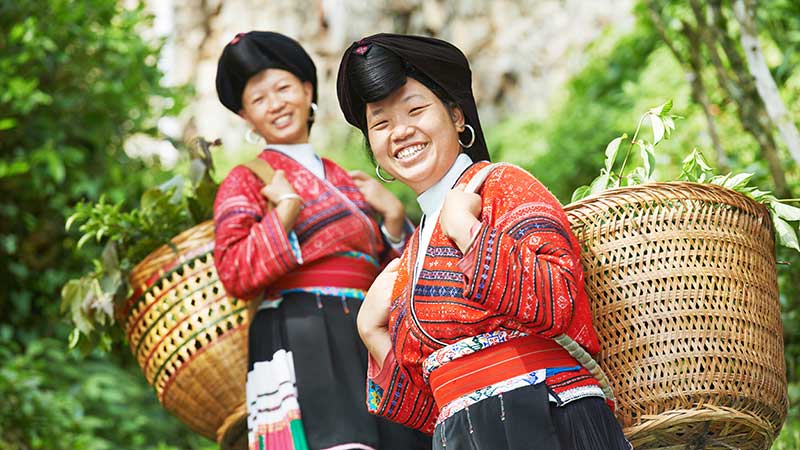
An equally quirky tradition maintained by the Red Yao people of Longshen is the Rapunzel-like length of their hair, which can grow to around 1.6 meters. In the interest of practicality, hair folded like a turban on top of the head.

Whether it’s the rice they grow and eat, or the fact they’ve never used commercial shampoo, it seems the hair of the Red Yao women is imbued with special power. When a Hongyao girl reaches 17, she usually has her hair cut to ear length according to the local coming of age tradition. Incredibly, this is the only time Hongyao women are allowed to cut their hair. The hair is kept and added to her hair coil later, together with the collected hair that falls out.

A young Hongyao woman wears headscarf before marriage because only the bridegroom can see her hair. After getting married and having children, she will use the kept hair to make the different coiled hairstyles without wearing a headscarf. Different hairstyles indicate the marital status of the woman, with a hat-like wrap around style showing a woman is married. They usually place a wooden or silver comb on the top of their hair, so hair can be combed whenever they feel the need.

Hair is soaked and washed in a secret hair cleanser mixed with orange peels, dregs of tea seed oil, and some medicinal herbs, all of which is added to rice water, when it is boiled and then fermented. It is then rinsed in spring water.

When and how to enjoy the best of the Longji Terraces

Longji Terraces

Every season is a postcard at the Longji Rice Terraces, so time your visit to coincide with panoramic perfection. The good news is, you can pretty much guarantee that any time you make the trek to Longji, you won’t be disappointed.

April to late JuneSeedlings transplanted in the flooded paddy fields. Expect to see Longji sparkle.
July to early SeptemberTerraces covered in a rich green hue as rice grows in the paddy fields.
Late September to NovemberAs harvest season kicks in, the ridged terraces of Longji are transformed to a gorgeous golden hue.
December to early FebruaryWith winter underway, the rice fields turn silvery white, marking the end of the annual cycle.

In terms of seeing the rice terraces up close, hiking is by far the best way to explore the area. Hike to the top in three to four hours, or enjoy a 50 minute walk to a panoramic view of the terraces.

And while you can cover considerable territory in a day, an overnight stay at one of the many guesthouses provides the opportunity for a richer experience. Enjoy time with the locals, savor delicious local food, like bamboo shoots, organic eggplants, seasoned beef, and rice wine.

The local specialty, bamboo rice, comes highly recommended. Requiring a special method of cooking over a fire, the dish’s ingredients, including corn, sweet potato, taro root, water, are ‘infused’ such that the resulting sticky rice is bamboo-flavored.

Getting to the Longji Terraces

Buses from Guilin are available for travel to the Longji Terraces, however expect to more than double your travel time if you decide on this option.

A better choice if your travel time is precious (and let’s face it, whose travel time isn’t?), is to take a guided tour with a local who knows the area and is well acquainted with the very best on offer here.

Travel can be arranged from Yangshuo too, however keep in mind that the distance between destinations is considerably more – around 65 kilometers – so weigh up your options about the best point of departure.

The Longji Terraces are a magical experience; certainly one that will be appreciated on site and long after your adventure here is over.

Entry Prices
Adults¥100*
Children (under 18 years old and above 120cm)¥60
Children (under 120cm)free
FoodYes
TransportYesTransport by car or bus
ToursYes
Family friendlyYes
Close to cityYes145 kilometers or 1.5 hours drive by car from Yangshuo
Opening hours24/7

* Purchase your ticket at the entrance to the Longji Terraces, then travel on the local shuttle bus to either Ping’an (25-30 minutes) or Jinkeng (45-50 minutes). In addition to the shuttle bus ticket, visitors must also pay for the other optional activities available including the cable car at Jinkeng, Huangluo Redyao village, and the performance of folk song and dance.

A visit to the Longji Rice Terraces is one that captivates the imagination of travelers to China. It has all the hallmarks of a quintessentially authentic Chinese experience – magnificent scenery, traditional culture, the opportunity to connect with locals, a chance to enjoy regional food. If you’re planning travel to Guilin or Yangshuo, why not consider extending your time in the area by taking a trip to Longsheng? You can do that with ease through ChinaTours.com. Make the most of every minute of your vacation and enjoy a fully guided experience, allowing you to relax and learn all there is to know about this incredible corner of China. Reach out to our travel team  with your questions. We are here to help.

forbidden city

Forbidden City

forbidden city

Forbidden City: Things to do in Beijing, China

Locals call the Forbidden City Gu Gong (故宫), which literally translates as ‘former palace’. Considering the Chinese penchant for highly descriptive names, ‘former palace’ is a decidedly unimaginative moniker for what many consider the most marvelous of all China’s ancient buildings.

The Forbidden City holds great appeal for any history enthusiast. Within its walls, you will gain special insights to the life and times, not only of China, but of the million or so who built it, and those who lived and worked within its walls.

 Zijincheng (紫禁城) or Purple Forbidden City, as it is also known, most definitely appears to fit the bill as a city. It is the largest palace in the world, covering a total area of 720,000m2, and in 1987, UNESCO designated it as a World Heritage site. As the celestially ordained home of the emperor, the palace was a no-go zone for outsiders, hence the term ‘forbidden’. To risk entry was to risk life, however restrictions have eased greatly since empirical occupation and tickets for visitors today range between ¥40 and ¥60.

For a western traveler making their foray into the Forbidden City, it’s quite easy to feel overwhelmed and have no idea of where to start, so with that in mind, we’ve done our best to curate this ‘how to’ guide for a visit to this one-time home of rituals, riches, and often thwarted romance.

Forbbiden city

Forbidden City: Important facts

Let’s start with some Forbidden City facts.

Clearly, Yongle Emperor, the third Ming dynasty emperor, thought carefully about his decision to locate the palace in Beijing’s heart; auspiciously on the city’s central axis. His safety concerns – something every emperor faced – prompted him to move his court from Nanjing to Beijing and so building commenced in 1406. In keeping with this theme of ‘prevention is best’, the palace was designed to be impenetrable from the outside, with every conceivable eventuality considered in the design.

As with a great many historical projects of scale in China, the Forbidden City absorbed a massive workforce, said to have reached a million laborers and 100,000 artisans during its 14 -year construction. Preparation work that included collection of precious timbers and stone took eleven years, while specifically designed pavers and bricks were made in Suzhou and Linqing. Perhaps in the context of the palace’s longevity these can be seen as reasonable investments. The imperial palace served as the residence and court of 14 Ming dynasty emperors and 10 Qing dynasty emperors between 1420 and 1911. While restoration is a permanent activity at the Forbidden City, the longevity of the buildings and surrounds are a testament to the foresight and technical acumen of those involved in its design and construction.

Exploring the palace complex: Allow at least a day

The palace complex is a rectangle, surrounded by a 10 meter high wall and moat that stretches for a phenomenal 52 meters. From north to south, it extends 961 meters, and from east to west, 753 meters. When a survey of the entire palace complex was undertaken in 1973, it identified over 90 compounds, 980 buildings, and 8,728 rooms. In reality, the Forbidden City was a city within a city.

A large gate dominates each of the rectangle’s four walls.

SouthMeridian Gate (Wu Men)
NorthGate of Divine Prowess (Shenwu Men)
EastEast Prosperity Gate (Donghua Men)
WestWest Prosperity Gate (Xihua Men)

Each gate was designated to a specific group of people while the palace was inhabited, however since 2011, visitors may enter only via the south gate (Wu Men), but can exit via the north (Shenwu Men) and east (Donghua Men) gates. Each corner of the palace’s perimeter is distinguished by a uniquely designed watchtower or jiao lou.

forbidden city

The Meridian gate (south) was the main entry and is really a complex or superstructure of buildings with arches or doorways. The buildings are referred to as the ‘Five Phoenix Turrets’. Almanacs and announcements were issued from the gatehouse.

Forbidden City: Halls and hallmarks

The palace comprises two main parts; the outer court is south, while the inner court is located in the north. The outer court is where the emperor held court and grand audiences. After stepping through the Meridian Gate, you immediately see a large square with five marble bridges arching over the man-made Golden Water River.

The Gate of Supreme Harmony is fronted by two giant bronze lions. Charged with the task of guarding the palace, the lions stand 4.4 meters high. The lion on the left (as you face it) is a male with its paw placed on an embroidered wall. A female lion guards from the opposite side and has its left paw on a lion cub, a symbol of the royal family’s prosperity.

forbidden city

Located behind the gate is Supreme Harmony Square. Three magnificent buildings stand on the tiered marble terrace.

Hall of Supreme Harmony (Taihe Dian)Important ceremonies held here, including crowning the emperor, birthday, wedding, Chinese New Year
Hall of Central Harmony (Zhonghe Dian)Where the emperor rested or met officials prior to ceremonies
Hall of Preserving Harmony (Baohe Dian)Where the emperors of the Ming dynasty changed their formal clothes before ceremonies. During the Qing dynasty it was used for banquets attended by nobility and high ranking officials. Imperial examinations were also held here.

As is characteristic of the Forbidden City, there are many design features rich in symbolism. Along the marble terraces of the halls, there are 1,142 dragon heads. Of course, these are highly decorative, however they have a dual function as water drainage. Rainfall flows through the dragons’ mouths into an underground tunnel, where it meets the mouth of man-made Golden Water River located at the south end of the palace. This ingenious design prevents the Forbidden City from ever flooding.

Why no trees?

forbidden city

Apart from the sheer size of the palace, many visitors are struck by the complete absence of trees in the vast area that spreads out in front of the Gate of Supreme Harmony. There are commonly cited theories with fire prevention being the first of these, because many buildings and structures are made of timber. In fact, 308 giant bronze vats are located all around the palace, making it possible to put out fire, if needed.

A second reason was more aesthetic. The expansive area provided the ideal stage on which the majesty and grandeur could be showcased. The emperor’s life was always precariously in the balance, with the threat of assassins ever present. By limiting the places to hide, the emperor could also feel safe in the knowledge the 15 levels of pavers and bricks (carefully arranged in alternating horizontal and vertical layers) would prevent even the most ardent of threats from digging deep and tunnelling their way into the palace. The ‘five element’ theory is also floated as a reason no trees are planted here.

Who lived at the Forbidden City?

forbidden city

The northern part of the Forbidden City is the Inner Court. It is here you would have found the emperor and his consorts in residence, as well as venues for religious rituals and administration. In this area, there are also three main buildings located on the area’s central axis (and center).

Palace of Heavenly Purity (Qianqing Gong)Official residence of the emperor. Later became the place emperors conducted routine government business and celebrated major festivals and rituals
Hall of Union (Jiaotai Dian)Where the empress received greetings from her high-ranking subjects on major festivals
Palace of Earthly Tranquility (Kunning Gong)Residence of the Empress. Was also once the Shamanism sacrificial hall and imperial bridal chamber

On both sides of the main axis were the Six Eastern Palaces and Six Western Palaces, which were the private residences of the imperial consorts and concubines. At the far end of the Inner Court, you will find the Imperial Garden, enormous at 10,000m2, and on each of its sides are the residences that housed the imperial princes and princesses.

Many westerners are curious about the number of imperial consorts and concubines kept by an emperor. This number varies, however Emperor Kangxi, China’s longest reigning emperor (61 years from 1661 to 1722), had four empresses and over 40 consorts, concubines, noble ladies and mistresses.

Emperor Yongzheng, the Qing Dynasty’s fourth emperor, resided and presided over state affairs in the Hall of Mental Cultivation (Yangxin Dian). Empress Dowager Cixi and Cian managed state affairs here – but behind the scenes – for Emperors Tongzhi and  Guangxu. And it was in the Hall of Mental Cultivation that China’s last emperor Puyi abdicated from the throne after the 1911 revolution broke out. While Puyi was allowed to live in the Inner Court after his abdication, in 1924 he was expelled, and a committee was established to take over the palace and care for the vast collection of imperial treasures which number over 1.8 million individual pieces. The now famous Palace Museum was opened to the public in 1925, just one year after Puyi’s departure.

Palace Museum: A treasure in its own right

It is said that just over 40 percent of China’s valuable cultural relics are housed at the Palace Museum. Including a vast selection of bronze, ceramic, and jade pieces, as well as paintings, calligraphy, palace objects, and ancient books, only a relatively small number are displayed in more than ten galleries at the museum.

forbidden city

It’s an understatement to say the Palace Museum is immensely popular. Ranked as the most visited museum in the world, a daily limit of 80,000 visitors was set in 2015 to improve the experience and to support preservation efforts.

If possible, time your visit to spring or autumn, before the summer crowds flock and Beijing is deep in the throes of its typically icy winter. International travelers must provide their passport name and number when booking tickets, which should be purchased in advance rather than on the day to help with a speedy entry. You must present your passport on entry in exchange for a ticket bearing a QR code.

Entry Prices
Adults1 Apr – 31 Oct¥60
1 Nov – 31 Mar¥40
Treasure Gallery¥10
Hall of Clocks¥10
Children6 – 18 yearsHalf price
ChildrenUnder 1.2 meters and < 6 yearsFree
FoodYesVarious food and beverage outlets both inside and outside the Forbidden City. Our local insider tip? Ask your guide for directions to the Forbidden City’s Hidden Ice Restaurant: Bingjiao Cafe
TransportYesBus, subway and taxi (no parking)
ToursYesFully guided including transport to the base
Family friendlyYes
Close to cityYes
Opening hours1 Apr – 31 Oct8.30am – 5.00pm

1 Nov – 31 Mar

8.30am – 4.30pm

Enjoy the opportunity to get up close with China’s imperial history with a visit to the Forbidden City. Make the most of your travel time with a guided tour and discover all the mystery, intrigue, and beauty within the four walls of the palace. Few places captivate in the way the Purple Palace does, so let us help make it the beautiful travel memory it should be. We can assist with bookings and travel arrangements for a single day tour of the Forbidden City – or a multi-destination adventure across China. Reach out here  and we’ll respond within 24 hours.